

Search engine optimization (SEO) has always evolved with technology. Today, artificial intelligence is changing the industry faster than ever. From Google’s AI Overviews to AI-powered keyword research, AI is transforming how websites are discovered, ranked, and optimized. As a result, SEO professionals must rethink their strategies.
Today, SEO professionals are no longer asking whether they should use AI—they’re asking how to use it effectively without sacrificing quality, originality, or user experience.
In this guide, you’ll learn how AI is transforming SEO, explore the best AI SEO tools, and discover practical strategies for long-term success.
What Is Artificial Intelligence in SEO?
Artificial intelligence in SEO uses machine learning, natural language processing (NLP), and generative AI to improve every stage of SEO. These technologies help marketers work faster and make better decisions.
Instead of relying only on manual research, AI analyzes ranking signals, finds keyword opportunities, improves content, and monitors website performance in minutes.
Common applications include:

- Keyword research
- Content optimization
- Technical SEO analysis
- Competitor research
- Internal linking recommendations
- Search intent analysis
- AI-powered content creation
- SEO performance monitoring
The goal isn’t to replace SEO professionals but to help them make faster, more informed decisions.
Why AI Is Changing SEO
Search engines have become significantly smarter.
Today, Google understands context and user intent instead of matching keywords alone. As a result, successful SEO focuses on helpful, high-quality content rather than keyword repetition.
AI helps marketers adapt to the rapidly changing search landscape by discovering emerging search trends and identifying content gaps before competitors do. It also improves content readability, enhances semantic relevance, predicts user intent more accurately, and automates repetitive SEO tasks. As a result, marketers can create higher-quality content, make data-driven decisions, and improve their search engine rankings more efficiently.
As a result, As AI search continues to evolve, websites that prioritize expertise, helpfulness, and topical authority are more likely to perform well.
SEO for AI Search: A New Way of Thinking
Traditional SEO focused on ranking among ten blue links.
Today, SEO for AI Search goes further by helping your content become a trusted source for AI-generated answers.
AI-powered search reviews information from many trusted sources. Because of this, authority and credibility are more important than ever.
To optimize for AI search:
- Answer questions directly.
- Cover topics comprehensively.
- Use descriptive headings.
- Add statistics and real-world examples.
- Cite trustworthy sources.
- Demonstrate expertise and experience.
- Keep content updated.
These practices increase the likelihood of your content being referenced by AI-powered search systems.
How to Show Up in AI Overviews
One of the fastest-growing SEO topics is how to show up in AI Overviews.
Although Google’s AI Overviews summarize information from multiple trusted sources to answer user queries directly within search results.
Although there’s no guaranteed method for appearing in AI Overviews, websites can improve their chances by:
| Strategy | How to Apply It |
|---|---|
| Create Helpful Content | Focus on solving users’ problems rather than writing only for search engines. |
| Answer Questions Clearly | Provide concise answers first, then expand on the topic with more details and examples. |
| Build Topical Authority | Publish multiple high-quality articles on the same subject instead of isolated posts. |
| Use Structured Content | Organize your content with clear H2 and H3 headings, bullet points, comparison tables, and FAQs. |
| Improve Technical SEO | Ensure your website loads quickly, is mobile-friendly, easy to crawl, and uses structured data where appropriate. |
Generative AI SEO: Opportunity and Responsibility
Generative AI SEO involves using AI tools to assist with content creation, ideation, optimization, and research.
For example, These tools can:
- Generate outlines
- Suggest titles
- Expand ideas
- Improve readability
- Identify missing subtopics
- Optimize metadata
However, publishing AI-generated text without human review can lead to factual inaccuracies, repetitive wording, or weak originality.
The most effective approach combines AI efficiency with human expertise.
Think of AI as an assistant—not the author.
Best Free AI SEO Tools
Many businesses want to improve rankings without investing heavily in software.
Fortunately, Some of the best free AI SEO tools include:
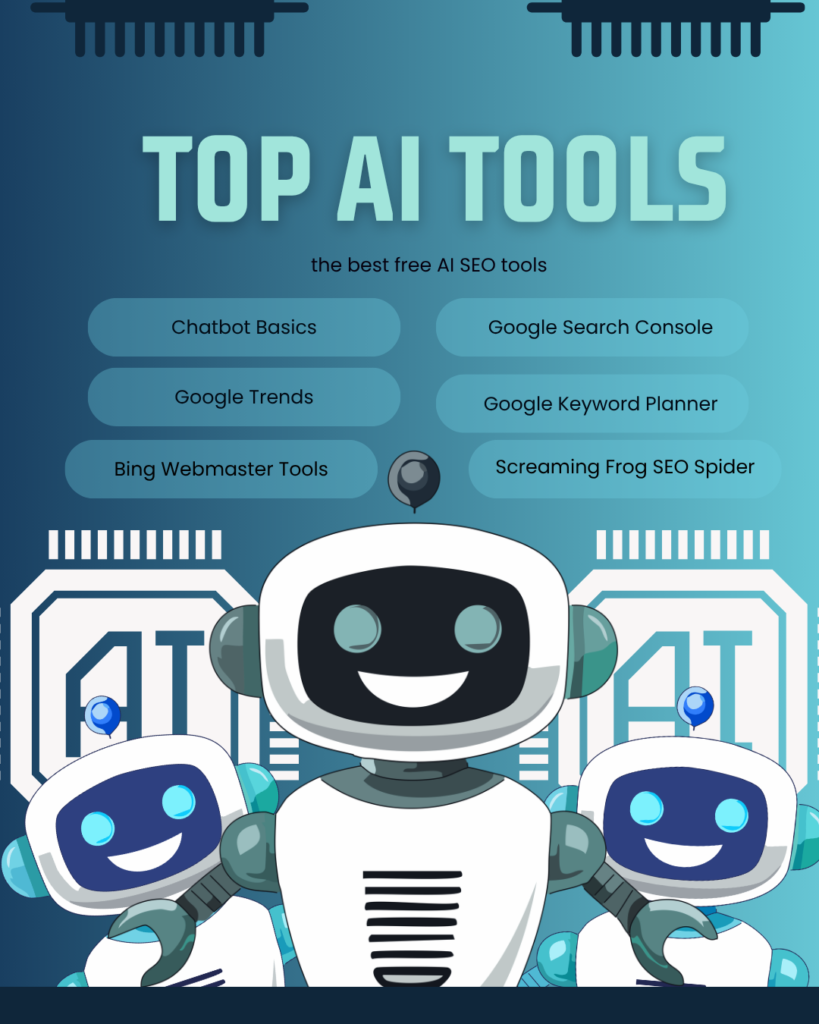
- ChatGPT for brainstorming, outlines, and content refinement
- Google Search Console for search performance analysis
- the Google Trends for identifying trending topics
- Google Keyword Planner for keyword discovery
- Bing Webmaster Tools for technical insights
- Screaming Frog SEO Spider (free version) for site audits
Meanwhile, Paid platforms such as Semrush, Ahrefs, Surfer SEO, Clearscope, and Frase offer more advanced AI-powered optimization features.
How to Monitor SEO Performance in AI Search
Traditional ranking reports are no longer enough.
Instead, Businesses should monitor:
| SEO Metric | Why It Matters |
|---|---|
| Organic Traffic | Track whether AI-related updates affect your search visibility. |
| AI Overview Appearances | Identify which pages appear in AI-generated search experiences. |
| Click-Through Rate (CTR) | Monitor how users interact with your search listings. |
| User Engagement | Measure time on page, bounce rate, and conversions to evaluate content performance. |
| Keyword Visibility | Track rankings across both traditional search results and AI-enhanced search experiences. |
The Future of SEO with AI
The future of SEO isn’t about replacing human marketers.
It’s about creating better content faster while using AI to make smarter decisions.
Looking ahead to 2030, SEO is expected to become more intelligent and user-focused. Search engines will increasingly rely on conversational search, voice search, and personalized results to deliver more relevant answers. At the same time, AI assistants, semantic understanding, and entity-based optimization will play a larger role in how content is discovered and ranked. User experience signals and strong brand authority will also become even more important, helping businesses build trust and improve their visibility in an AI-powered search environment.
Businesses that embrace these changes today will be better positioned for tomorrow’s search landscape.
AI SEO Strategy for Long-Term Success
A successful AI SEO strategy includes five core steps:
| AI SEO Strategy | Description |
|---|---|
| 1. Understand Search Intent | Every article should answer the user’s actual question instead of focusing only on keywords. Understanding search intent helps create content that meets users’ needs and improves rankings. |
| 2. Build Topic Clusters | Publish multiple related articles around a central topic to establish topical authority and make it easier for search engines to understand your expertise. |
| 3. Optimize for Humans First | Create content that is clear, engaging, and valuable for readers. High-quality, user-focused content consistently performs better than pages filled with keywords. |
| 4. Use AI Responsibly | Use AI to support research, content planning, and optimization, but always review and refine the output with human expertise before publishing. |
| 5. Update Existing Content | Regularly refresh older articles with new information, updated statistics, and current SEO best practices to maintain rankings and maximize long-term results. |
Frequently Asked Questions
What is SEO for AI?
SEO for AI involves optimizing content so AI-powered search engines and assistants can easily understand, trust, and reference it when answering user questions.
What are the best free AI SEO tools?
Popular free options include ChatGPT, Google Search Console, Google Trends, Google Keyword Planner, Bing Webmaster Tools, and the free version of Screaming Frog.
Can AI improve SEO rankings?
AI can improve SEO by streamlining keyword research, content optimization, technical audits, and performance analysis. Rankings still depend on content quality, relevance, authority, and user experience.
How do I show up in AI Overviews?
Publish comprehensive, accurate, and well-structured content, answer questions clearly, build topical authority, and follow technical SEO best practices.
What is Generative AI SEO?
Generative AI SEO is the practice of using AI tools to assist with content creation, optimization, research, and workflow automation while maintaining human oversight.
What is the future of SEO in 2030?
SEO is expected to become more conversational, entity-focused, and AI-driven, with greater emphasis on expertise, trustworthiness, user intent, and high-quality content.
Recommended Internal Links
Link this article to related resources such as:
- Beginner’s Guide to SEO
- Technical SEO Checklist
- Keyword Research Guide
- On-Page SEO Best Practices
- Content Marketing Strategy
- Google Search Console Tutorial
- AI Writing Tools Comparison
External Resources
To deepen your understanding of AI-powered SEO, consult trusted industry resources such as Google Search Central for official SEO documentation, the Google Search Quality Evaluator Guidelines to learn how Google assesses content quality, and the Google Search Console Help Center for website performance insights. You can also stay up to date with the latest SEO trends and best practices by following the Semrush Blog, Ahrefs Blog, and Microsoft Bing Webmaster Guidelines. These resources provide valuable guidance for improving your SEO strategy and adapting to the evolving landscape of AI-powered search.
Conclusion
Artificial intelligence is redefining how search engines evaluate and present content, but the fundamentals of SEO remain the same: create valuable, accurate, and user-focused experiences.
AI can accelerate research, streamline optimization, and uncover opportunities that would otherwise take hours to find. Yet lasting success still depends on human expertise, originality, and a deep understanding of your audience.
Rather than viewing AI as a replacement for SEO, treat it as a powerful partner. By combining intelligent automation with high-quality content and sound optimization practices, you’ll be well prepared for the future of AI search.
If you’re ready to improve your search visibility, start by auditing your existing content, optimizing for AI Overviews, and building comprehensive topic clusters that genuinely answer your audience’s questions. The websites that adapt today will be the ones leading search results tomorrow.